Find
Published on 02/10/2026
Gender-based violence does not always start with a slap. Often it hides in behaviours that are socially accepted and that many people still see as normal: constant jealousy, a partner who checks where you go and what you wear, a joke that makes you feel small in public.
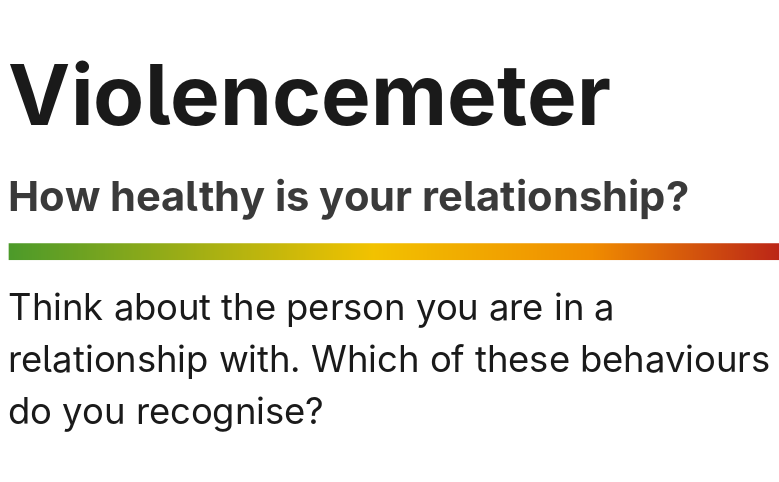
The Violencemeter helps people see these signs. It is a short list of 23 behaviours, from the healthiest to the most dangerous, divided into three colours:
The idea is simple. You think about the person you are in a relationship with and ask yourself which of these behaviours you recognise. We designed it to be easy to use in non-formal settings, such as local and international volunteering and youth activities. There, it can open a conversation that is often hard to start, and help prevent violence before it begins.
The Violencemeter was first used in Latin America and then in France. Our version updates it and also takes into account how digital technologies have changed relationships. This is why it includes behaviours such as demanding to check your messages, emails and apps, insisting on receiving intimate photos and threatening to share them.
Each national version also lists the numbers and contacts of the services to call, both in an emergency and in situations of violence, adapted to each country. Where possible, it also shows how people who cannot speak or who are deaf can reach emergency services, for example by text message or through an app.
The international version is not linked to a specific country. For this reason, it invites people to contact an anti-violence centre or to call 112, the European emergency number.
The contacts are based on the data kept up to date by two European sources: the list of helplines of the WAVE (Women Against Violence Europe) network and the emergency means database of BEREC, the Body of European Regulators for Electronic Communications. Where these data were not available, we collected the contacts directly ourselves.
We also designed the Violencemeter to be accessible. Every version is a PDF file that screen readers and other speech synthesis software can read aloud, and every image has a text description. The colours have a strong contrast, so the text is easy to read.
The Violencemeter is only one part of our work. At IGNet, the European network coordinated by InformaGiovani, we work to prevent gender-based violence, to respond to it and to manage cases when they happen. For this reason, we are also preparing training materials and developing policy models that civil society organisations can adopt inside their own structures.
We created the national versions together with our partner organisations, who helped us adapt the Violencemeter to their languages and countries. Below you can find the international version and all the national versions.
For questions or suggestions, write to us at gbv-prevention@ignet.eu.